
Table of Contents
MW vs MWh, the short answer: A megawatt (MW) measures power, the rate at which a plant produces or a battery delivers electricity at one moment. A megawatt-hour (MWh) measures energy, the amount produced, stored or sold over time. One MWh is one MW held for one hour.
Project summaries, battery specifications and power contracts put the two units side by side: "a 120 MW solar plant that produces 300,000 MWh a year", "a 100 MW / 400 MWh battery", "55 per MWh". This article explains MW vs MWh, shows how to convert between them, and takes a close look at batteries, where you need both numbers at once.
What is a megawatt (MW)?
A megawatt is a unit of power. Power is a rate: how fast electricity is produced or used right now. One megawatt is 1,000 kilowatts, or one million watts.
The capacity of a power plant is stated in megawatts. A modern onshore wind turbine can deliver about 5 MW in strong wind. A large solar plant might feed 120 MW into the grid. A large nuclear reactor delivers about 1,000 MW, which is 1 gigawatt (GW).
What is a megawatt-hour (MWh)?
A megawatt-hour is a unit of energy. Energy is an amount: what the rate adds up to over time. One megawatt-hour is 1,000 kilowatt-hours. It is what a plant's meter counts and what the buyer of its electricity pays for.
Energy (MWh) = Power (MW) × Time (hours)
40 MW × 5 hours = 200 MWh
For a sense of scale: a home in the United States uses about 10.5 MWh of electricity in a year, and a home in Great Britain about 2.7 MWh.
The two-minute video below explains the difference between MW and MWh.
Free PDF · The RVA Body of Knowledge
The complete curriculum of renewable energy project finance
42 readings in five topic areas, from power and energy to debt sizing and battery storage, with practice questions after every reading. The Complete Edition is free.
How to convert MW to MWh
You cannot convert megawatts into megawatt-hours without a time. Once you have the time, the conversion is one multiplication. A year has 8,760 hours (365 × 24).
| Question | Calculation | Result |
|---|---|---|
| A 40 MW plant runs for 5 hours at full output | 40 MW × 5 h | 200 MWh |
| The most a 25 MW plant can produce in a day | 25 MW × 24 h | 600 MWh |
| The most a 25 MW plant can produce in a year | 25 MW × 8,760 h | 219,000 MWh |
| A 25 MW wind farm at a capacity factor of 30% | 25 MW × 30% × 8,760 h | 65,700 MWh |
| The average output behind 65,700 MWh a year | 65,700 MWh ÷ 8,760 h | 7.5 MW |
Real plants produce less than their ceiling, because wind and sunlight vary. The share of the ceiling that a plant delivers in a year is its capacity factor. Try your own numbers:
Calculator
From megawatts to megawatt-hours in a year
Production in a year: 65,700 MWh
Average output: 7.5 MW · Ceiling at full output all year: 219,000 MWh
Equal to the annual use of 16,425 homes
Production = capacity × capacity factor × 8,760 hours. The capacity factor is the share of its full-output ceiling that a plant delivers in a year. The homes figure is the yearly production divided by the yearly use of one home: see how many homes 1 MW can power.
MW vs MWh for batteries: power, energy and duration
A battery is the one asset that carries both units in its name. A "100 MW / 400 MWh" battery can charge or discharge at up to 100 MW, and it can hold 400 MWh. Dividing one by the other gives the third number, the duration.
Duration (hours) = Energy capacity (MWh) ÷ Power rating (MW)
400 MWh ÷ 100 MW = 4 hours
It helps to picture a battery as a rectangle. The height is the power rating, the width is the duration and the area is the energy capacity.
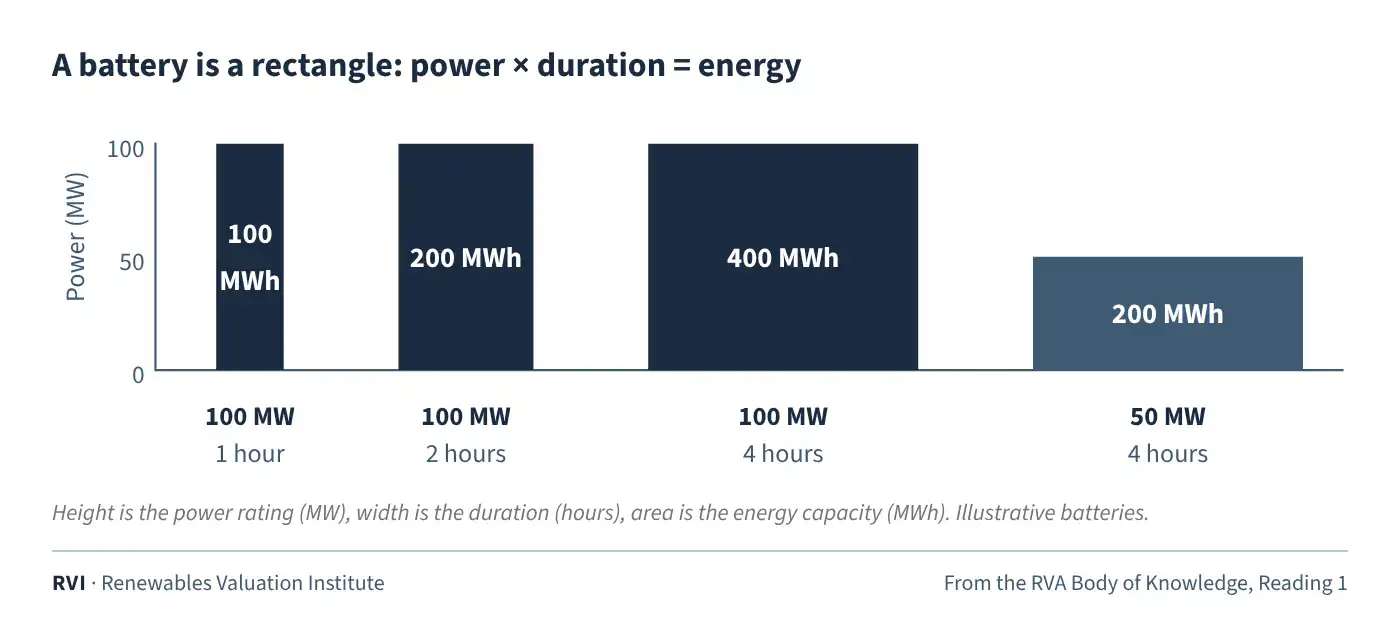
Two batteries with the same MW are different assets if their MWh differ, and so are two batteries with the same MWh and different MW. A 100 MW / 200 MWh battery and a 50 MW / 200 MWh battery store the same energy, but the first can deliver it twice as fast.
Calculator
Battery duration from MW and MWh
A 100 MW / 400 MWh battery lasts 4 hours at full power
At half power it lasts 8 hours
Duration = energy capacity ÷ power rating. A simplification: it leaves out losses and the limits on how far a battery is charged and discharged.
The division is a simplification. It leaves out losses and the limits on how far a battery is charged and discharged. The articles on AC vs DC in battery storage and on the revenue model of a battery tolling agreement go into that detail.
MW vs MWh in contracts and prices
Payments follow the same split.
- Energy payments are made per MWh delivered. A plant that sells 300,000 MWh at 55 per MWh earns 16.5 million a year. A power purchase agreement works this way.
- Capacity payments are made per MW or kW held available, per month or per year. A 100 MW battery that is paid 8.00 per kW-month earns 100,000 kW × 8.00 × 12 = 9.6 million a year, whether or not it is dispatched.
The unit after "per" tells you which quantity a price has to be multiplied by. A price per MWh needs megawatt-hours. If you only have megawatts, turn them into megawatt-hours first: MW × hours = MWh.
Common mistakes with MW and MWh
"MW per year." "The plant generates 50 MW per year" is not an amount. Generation over a year is stated in MWh or GWh.
"A 100 MW battery." This is half a specification. Without the MWh you do not know whether the battery lasts one hour or four.
Production above the ceiling. A 10 MW plant cannot have produced 120 GWh in a year. Its ceiling is 10 MW × 8,760 h = 87,600 MWh, or 87.6 GWh.
Key takeaways: MW vs MWh
- MW is power: a rate at one moment. Capacity is stated in MW.
- MWh is energy: an amount over time. Production and sales are stated in MWh.
- MWh = MW × hours, and average MW = MWh ÷ hours.
- A year has 8,760 hours. Capacity × 8,760 hours is the most a plant can produce in a year.
- A battery needs both numbers. Duration = MWh ÷ MW.
- Energy is paid per MWh, capacity per MW or kW held available.
Practice questions
Three questions in the format of the RVA Body of Knowledge. Pick an answer to check it.
1. A 30 MW plant runs at full output for 20 hours. How much energy does it produce?
- 1.5 MWh
- 600 MWh
- 262,800 MWh
Show answer
B is correct. Energy = power × time = 30 MW × 20 h = 600 MWh. Option A divides the power by the time. Option C multiplies by the 8,760 hours of a whole year.
2. A battery is rated 50 MW / 200 MWh. For how long can it discharge at full power?
- 0.25 hours
- 4 hours
- 10,000 hours
Show answer
B is correct. Duration = energy ÷ power = 200 MWh ÷ 50 MW = 4 hours. Option A divides the power by the energy. Option C multiplies the two ratings, which gives no meaningful unit.
3. A wind farm produced 157,680 MWh in a year of 8,760 hours. What was its average output?
- 18 MW
- 157.68 MW
- 432 MW
Show answer
A is correct. Average power = energy ÷ time = 157,680 MWh ÷ 8,760 h = 18 MW. Option B only divides by 1,000, which turns MWh into GWh and not into power. Option C divides by 365 days, which gives MWh per day.
Free PDF · The RVA Body of Knowledge
The complete curriculum of renewable energy project finance
42 readings in five topic areas, from power and energy to debt sizing and battery storage, with practice questions after every reading. The Complete Edition is free.
Go deeper
MW vs MWh is one case of a wider distinction. These articles take the next steps:
- Energy vs power: the concept behind both units, with charts and more examples.
- The difference between kW and kWh: the same idea at the scale of a home.
- Full load hours and capacity factor: how much of its ceiling a plant delivers.
- The RVA Certification Program builds the financial models that turn megawatts and megawatt-hours into cash flows.
Sources: U.S. Energy Information Administration and Ofgem (household electricity use). The plant, battery and price examples are illustrative.
FAQs
What is the difference between MW and MWh?
MW vs MWh is the difference between a rate and an amount. A megawatt (MW) is a unit of power: how fast electricity is produced or used at one moment. A megawatt-hour (MWh) is a unit of energy: how much is produced or used over time. One MWh is one MW held for one hour.
How many MWh does 1 MW produce?
It depends on the time. At full output, 1 MW produces 1 MWh in an hour, 24 MWh in a day and 8,760 MWh in a year. Real plants produce less: at a capacity factor of 25%, 1 MW produces 2,190 MWh a year.
How do you convert MWh to MW?
Divide the energy by the time in hours. The result is the average power. A plant that produced 65,700 MWh in a year of 8,760 hours averaged 7.5 MW.
What does 100 MW / 400 MWh mean for a battery?
The battery can charge or discharge at up to 100 MW, and it can hold 400 MWh of energy. At full power it lasts 400 MWh ÷ 100 MW = 4 hours, so it is called a four-hour battery.
Is a MWh bigger than a MW?
The two cannot be compared, because they measure different things. A megawatt is a rate and a megawatt-hour is an amount, in the way that a speed in kilometers per hour cannot be compared with a distance in kilometers.
How long does 1 MWh power a home?
A home in the United States uses about 10.5 MWh of electricity in a year, so 1 MWh covers about five weeks. A home in Great Britain uses about 2.7 MWh a year, so 1 MWh covers more than four months.