
Table of Contents
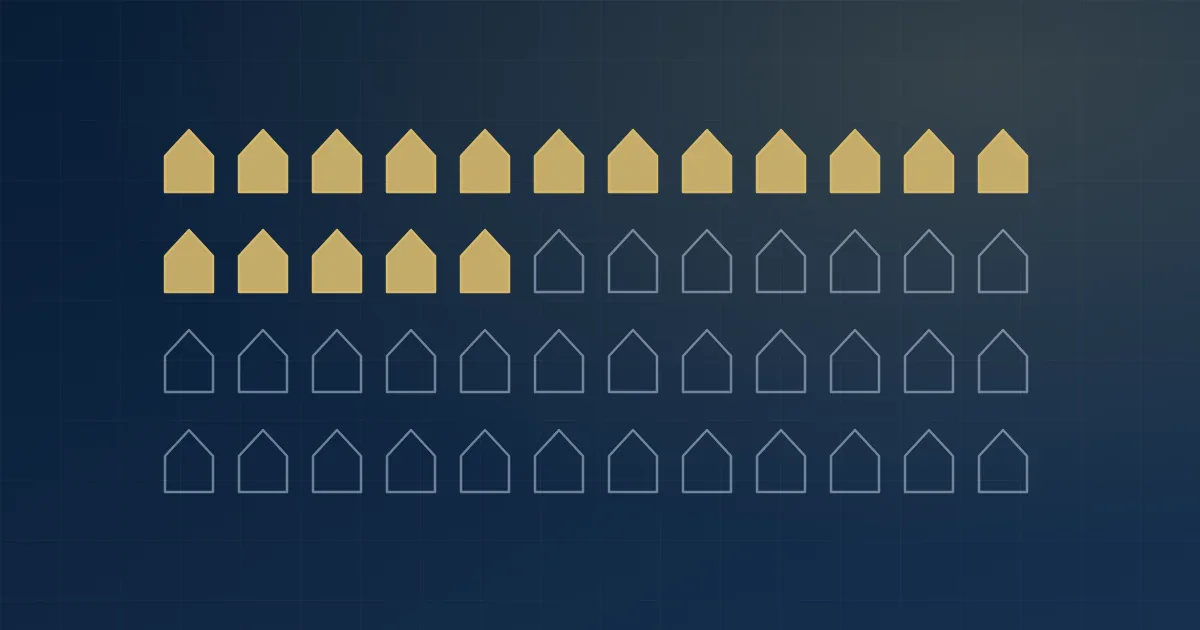
How many homes can 1 MW power? It depends on two numbers: how much the megawatt produces in a year, and how much electricity one home uses. One megawatt at a capacity factor of 25% produces 2,190 MWh a year. That equals the annual use of about 209 homes in the United States, 534 in France, 811 in Great Britain or 913 in Germany.
The phrase "enough to power 20,000 homes" appears in announcements for solar farms, wind farms and batteries. It compares megawatts, which are a rate, with what homes use over a year, which is an amount. This article shows the two steps of the calculation, how the answer changes with the country and the capacity factor, and how to check such a claim in a minute.
The formula: from megawatts to homes
A megawatt (MW) is a unit of power. Homes use energy, measured in kilowatt-hours or megawatt-hours over a year. So the calculation has two steps.
- Step 1, annual production: capacity (MW) × capacity factor × 8,760 hours = MWh a year.
- Step 2, homes: annual production ÷ annual electricity use per home.
Homes = MW × capacity factor × 8,760 h ÷ annual use per home
1 MW × 25% × 8,760 h = 2,190 MWh ÷ 10.5 MWh = 209 homes
The capacity factor is the share of its full-output ceiling that a plant delivers in a year. A plant that ran at full output in all 8,760 hours of the year would have a capacity factor of 100%. Try your own numbers:
Calculator
How many homes does a plant supply?
Production in a year: 2,190 MWh (average output 0.25 MW)
Equal to the annual use of 209 homes
Homes = annual production ÷ annual use per home. The result compares yearly totals. It does not mean that the homes are supplied in every hour.
Free PDF · The RVA Body of Knowledge
The complete curriculum of renewable energy project finance
42 readings in five topic areas, from power and energy to debt sizing and battery storage, with practice questions after every reading. The Complete Edition is free.
How many homes can 1 MW power in different countries?
The second number of the formula differs widely between countries. Air conditioning, electric heating and the size of homes are among the reasons.
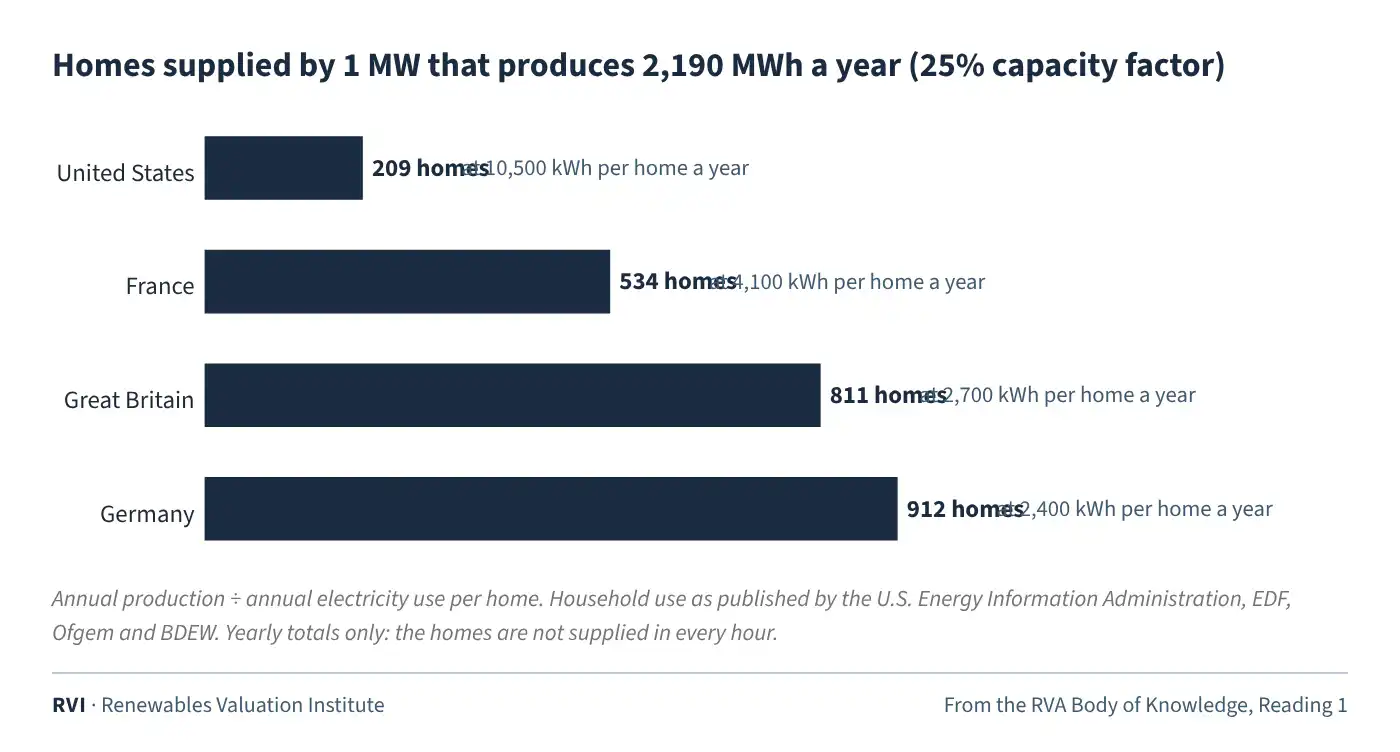
| Country | Electricity use per home (kWh a year) | Homes per MW at 2,190 MWh a year |
|---|---|---|
| United States | 10,500 | 209 |
| France | 4,100 | 534 |
| Great Britain | 2,700 | 811 |
| Germany | 2,400 | 913 |
| Average or typical values as published by the U.S. Energy Information Administration, EDF, Ofgem and BDEW. Definitions differ between sources. | ||
The same megawatt supplies more than four times as many homes in Germany as in the United States. Nothing about the plant has changed. Only the home has.
How many homes 1 MW powers at different capacity factors
The first number of the formula depends on the technology and the site. The table uses round capacity factors to show the effect.
| Capacity factor | Production per MW (MWh a year) | US homes (10,500 kWh) | British homes (2,700 kWh) |
|---|---|---|---|
| 15% | 1,314 | 125 | 487 |
| 25% | 2,190 | 209 | 811 |
| 35% | 3,066 | 292 | 1,136 |
| 50% | 4,380 | 417 | 1,622 |
| 90% | 7,884 | 751 | 2,920 |
Solar plants sit toward the lower end of this range, wind farms in the middle, and plants that run around the clock toward the upper end. One megawatt of capacity is therefore not one fixed number of homes. The article on MW vs MWh explains the step from capacity to production in more detail.
What a "homes powered" claim does not tell you
- It compares yearly totals. A solar plant produces nothing at night. The claim does not mean that the homes are supplied in every hour.
- It depends on the home. The same plant equals four times as many German homes as US homes.
- It depends on the megawatts. A solar plant has a DC rating of its modules and a lower or equal AC rating at the grid connection. The announcement may quote either.
- Homes are only part of demand. Factories, offices, data centers and transport use electricity too.
How to check a claim in three steps
Take the statement "our 50 MW solar farm will power 20,000 homes".
| Step | Calculation | Result |
|---|---|---|
| 1. Find or estimate the annual production | 50 MW × 25% × 8,760 h | 109,500 MWh |
| 2. Divide by the number of homes | 109,500 MWh ÷ 20,000 | About 5.5 MWh per home |
| 3. Compare with the country's typical use | 2.7 MWh in Great Britain, 10.5 MWh in the United States | Cautious for Great Britain, too high for the United States |
If the announcement states the expected production, use that figure in step 1 instead of an assumed capacity factor.
Common mistake: dividing megawatts by the average draw of a home. A US home that uses 10,500 kWh a year draws 1.2 kW on average. 1 MW ÷ 1.2 kW gives 834 homes. That would be right only for a plant that runs at full output in every hour of the year.
Key takeaways: how many homes can 1 MW power
- There is no single answer. The result depends on the plant's annual production and on the annual use of one home.
- Homes = MW × capacity factor × 8,760 hours ÷ use per home.
- At a 25% capacity factor, 1 MW equals about 209 US homes or 913 German homes.
- The claim compares yearly totals. It says nothing about supply in each hour.
- To check a claim, find the production, divide by the homes and compare the result with the country's typical use.
Practice questions
Three questions in the format of the RVA Body of Knowledge. Pick an answer to check it.
1. How much does 1 MW produce in a year of 8,760 hours at a capacity factor of 20%?
- 175 MWh
- 1,752 MWh
- 8,760 MWh
Show answer
B is correct. 1 MW × 20% × 8,760 h = 1,752 MWh. Option A has a decimal slip. Option C is the ceiling: the production at full output in every hour of the year.
2. A plant produces 50,400 MWh a year. Homes in its country use 3,600 kWh a year. Its production equals the annual use of how many homes?
- 1,400 homes
- 14,000 homes
- 140,000 homes
Show answer
B is correct. 3,600 kWh is 3.6 MWh. 50,400 MWh ÷ 3.6 MWh = 14,000 homes. Options A and C slip by a factor of 10 when the kWh are converted into MWh.
3. A press release says that a 45 MW solar farm producing 78,840 MWh a year "powers 30,000 homes". Which annual use per home does the claim assume?
- About 0.38 MWh
- About 2.6 MWh
- About 667 MWh
Show answer
B is correct. 78,840 MWh ÷ 30,000 homes = 2.63 MWh per home, or about 2,600 kWh a year. Option A divides the homes by the production. Option C divides the homes by the capacity in MW.
Free PDF · The RVA Body of Knowledge
The complete curriculum of renewable energy project finance
42 readings in five topic areas, from power and energy to debt sizing and battery storage, with practice questions after every reading. The Complete Edition is free.
Go deeper
- Energy vs power: why megawatts and megawatt-hours are different things.
- MW vs MWh: converting capacity into production, with battery examples.
- Full load hours and capacity factor: how to judge how much a plant produces.
- The RVA Certification Program shows how production becomes revenue in a financial model.
Sources: U.S. Energy Information Administration; EDF; Ofgem, Typical Domestic Consumption Values; BDEW. Capacity factors and plant examples are illustrative.
FAQs
How many homes can 1 MW of solar power?
At a capacity factor of 25%, 1 MW of solar capacity produces 2,190 MWh a year. That equals the annual electricity use of about 209 homes in the United States or about 811 homes in Great Britain. A sunnier or cloudier site changes the capacity factor and with it the answer.
How many homes can 1 MW of wind power?
At a capacity factor of 35%, 1 MW of wind capacity produces 3,066 MWh a year. That equals the annual use of about 292 homes in the United States or about 1,136 homes in Great Britain. A wind farm with a higher capacity factor supplies more.
How many homes can 1 GW power?
One gigawatt is 1,000 MW, so every result is multiplied by 1,000. At a capacity factor of 25%, 1 GW equals the annual use of about 209,000 US homes. At 90%, it equals about 751,000.
How much power does one home use?
A US home that uses 10,500 kWh a year draws 1.2 kW on average (10,500 kWh ÷ 8,760 hours). A British home that uses 2,700 kWh draws about 0.3 kW on average. The draw at any one moment is higher when appliances run and lower at night.
Why do answers to "how many homes can 1 MW power" differ so much?
The answer rests on two assumptions: the capacity factor of the plant and the annual use of one home. A megawatt that runs around the clock in a country with low household use can supply more than ten times as many homes as a solar megawatt in the United States.
Does "powers 20,000 homes" mean the homes get all their electricity from the plant?
No. The claim compares the plant's annual production with the annual use of the homes. A solar plant produces nothing at night, so in many hours the homes are supplied by other sources.