
Table of Contents
- Energy yield: definition and units
- Specific yield: energy yield per kWp
- Gross energy yield vs net energy yield
- From gross yield to the energy sold
- P50, P90 and the uncertainty of an energy yield
- What an energy yield assessment contains
- Common mistakes with energy yield figures
- Key takeaways: energy yield
- Go deeper
What is energy yield? Energy yield is the electricity that a wind farm or a solar plant produces in a period, by convention a year. It is stated as a total, in MWh or GWh a year, or per unit of installed capacity, as a specific yield in kWh/kWp. A 100 MWp solar plant with a net yield of 1,710 kWh/kWp produces 171,000 MWh a year.
Every valuation of a wind or solar project starts with one question: how much electricity will the plant produce? The answer is its energy yield. The term covers several figures, though. A gross yield, a net yield and the energy a project sells can lie far apart, and a figure is only useful once you know which of them it is. This article defines the terms, shows the units, and follows one plant from its gross yield to the energy it sells.
Energy yield: definition and units
The energy yield of a plant is its production of electricity over a period. It is stated in two ways.
- As a total: megawatt-hours or gigawatt-hours a year (MWh, GWh). Revenue is calculated from this figure.
- Per unit of capacity: the specific yield. For a solar plant the unit is kWh per kWp, which is the same number as MWh per MWp. For a wind farm it is MWh per MW, better known as full load hours. This figure lets you compare sites and plants of different sizes.
Energy yield (MWh a year) = installed capacity × specific yield
100 MWp × 1,710 MWh/MWp = 171,000 MWh a year
The megawatt-peak (MWp) is the unit of the DC rating of a solar plant: the capacity of its modules. Capacity is a rate and yield is an amount, a difference explained in MW vs MWh.
Specific yield: energy yield per kWp
The specific yield divides the annual production of a solar plant by the capacity of its modules.
Specific yield (kWh/kWp) = annual production (MWh) ÷ DC capacity (MWp)
300,000 MWh ÷ 150 MWp = 2,000 kWh/kWp
Energy divided by capacity leaves hours. A specific yield of 2,000 kWh/kWp says that the plant produced as much as 2,000 hours at its full module capacity would have given. It is the same measure as the full load hours of the plant on its DC rating. Dividing it by the 8,760 hours of a year gives the capacity factor: 2,000 ÷ 8,760 = 22.8%.
| Specific yield (kWh/kWp) | Capacity factor on the DC rating | Annual production of 100 MWp |
|---|---|---|
| 900 | 10.3% | 90 GWh |
| 1,100 | 12.6% | 110 GWh |
| 1,300 | 14.8% | 130 GWh |
| 1,500 | 17.1% | 150 GWh |
| 1,700 | 19.4% | 170 GWh |
| 1,900 | 21.7% | 190 GWh |
| 2,100 | 24.0% | 210 GWh |
Solar plants completed worldwide in 2025 reach an average capacity factor of 16.5% on the DC rating, according to the International Renewable Energy Agency. That corresponds to a specific yield of about 1,450 kWh/kWp. Single sites lie well below and above it, as the article on the solar capacity factor shows.
Gross energy yield vs net energy yield
An energy yield assessment does not arrive at one figure in one step. It starts with a larger number and works its way down.
- Gross yield is what the plant would produce without losses.
- Net yield is what remains after the losses inside the plant. Wind turbines stand in each other's wake. Rows of modules shade each other, dirt settles on the modules, hot modules produce less, and electricity is lost in cables, inverters and transformers on the way to the meter.
Assessments differ in what they deduct. Some already include an allowance for downtime or for curtailment in the net yield, and others leave both out. The loss table of the assessment shows which losses a net figure contains.
From gross yield to the energy sold
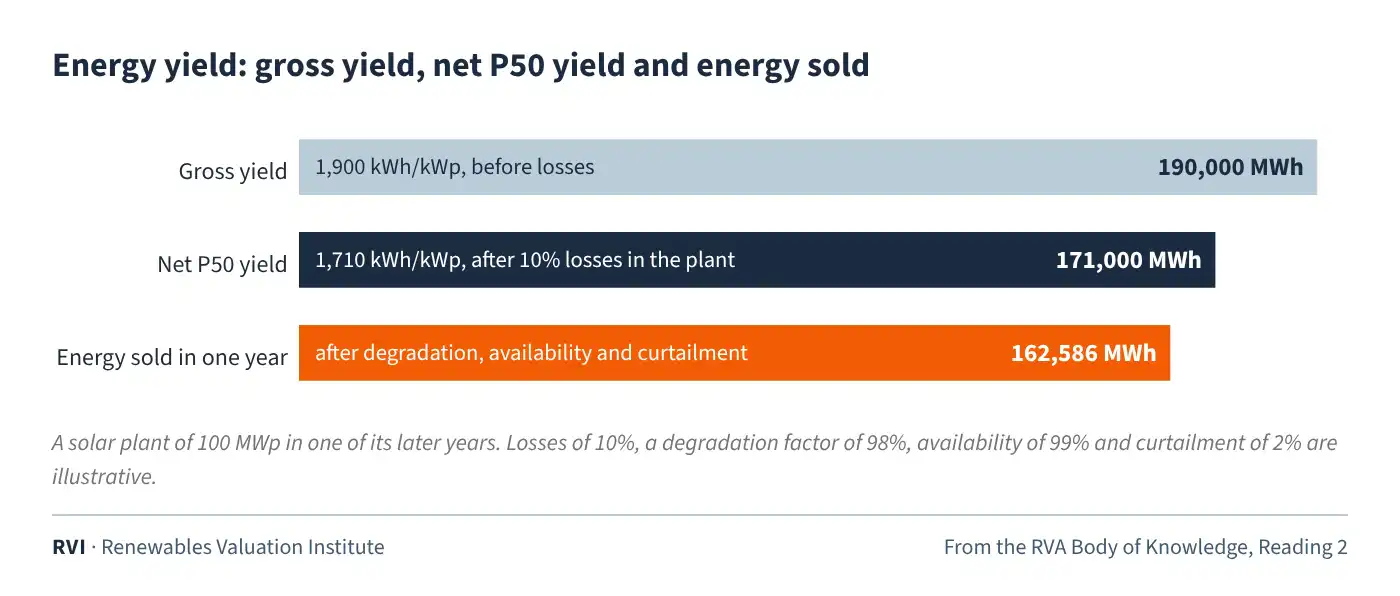
The net yield is still not the energy that a project sells in a given year. A financial model applies three more factors.
- Degradation: the slow decline of a solar module's output over its life. See what degradation is and how to model it.
- Availability: the share of time in which the plant is able to produce. Faults and maintenance take the rest.
- Curtailment: production that is held back on instruction, for example from the grid operator, although the plant could have produced it.
| Step | Calculation | Result |
|---|---|---|
| Gross yield | 100 MWp × 1,900 kWh/kWp | 190,000 MWh |
| Net yield | 190,000 MWh × (1 − 10% losses) | 171,000 MWh, or 1,710 kWh/kWp |
| Energy sold in the year | 171,000 MWh × 98% × 99% × 98% | 162,586 MWh |
| A solar plant of 100 MWp in one of its later years of operation. The losses of 10%, the degradation factor of 98%, the availability of 99% and the curtailment of 2% are illustrative. | ||
Between the first figure and the last lie 27,414 MWh, about 14% of the gross yield. On the DC rating the three figures are capacity factors of 21.7%, 19.5% and 18.6%. A yield without its stage can therefore be off by more than a tenth. Try the steps with your own numbers:
Calculator
From gross yield to energy sold
Net yield: 1,710 kWh/kWp · as a capacity factor on the DC rating: 19.5%
Net production in a year: 171,000 MWh
After availability and curtailment: 165,904 MWh
Net yield = gross yield × (1 − losses). Production = DC capacity × net yield. Availability and curtailment are applied afterwards, each once. In later years the degradation of the modules lowers the result further.
The RVI standard, and common market practice, is to enter the net P50 yield into the model before availability, degradation and curtailment, and to give each of the three a row of its own. A reader of the model can then see every assumption and change it.
Free PDF · The RVA Body of Knowledge
The complete curriculum of renewable energy project finance
42 readings in five topic areas, from power and energy to debt sizing and battery storage, with practice questions after every reading. The Complete Edition is free.
P50, P90 and the uncertainty of an energy yield
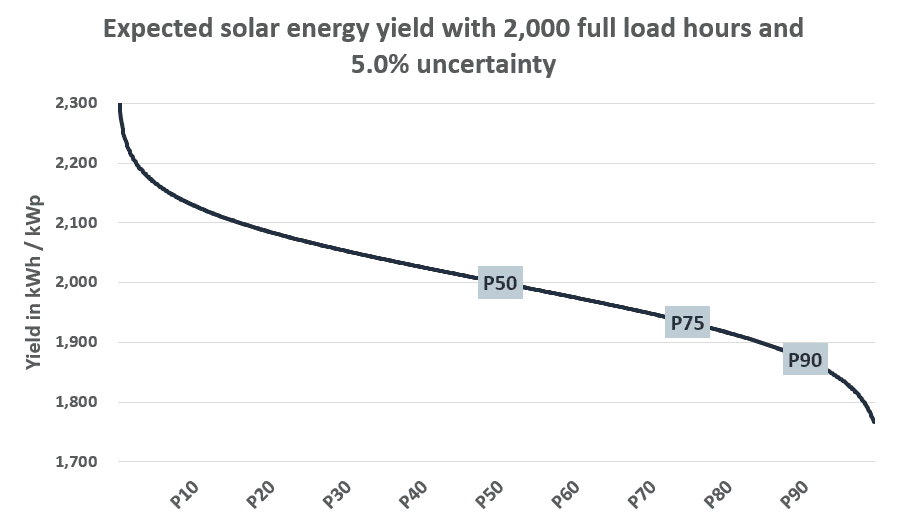
An energy yield is a forecast, and the weather of a single year differs from the long-term average. An assessment therefore states its result with a probability. The P50 yield is the annual production that the plant is as likely to exceed as to miss. The P90 yield is the lower level that the plant exceeds with a probability of 90%.
A financial model takes the P50 as the starting point of its production forecast, and lenders test the debt against lower cases. Two articles go further: how to model the P50, P75 and P90 energy yield and P50 vs P99: how lenders size debt.
What an energy yield assessment contains
For a real project you do not pick a yield from a table. The figure comes from an energy yield assessment, which a technical advisor prepares from measurements at the site and from the design of the plant. Its parts follow the path of this article.
- The resource: the wind speeds or the solar irradiation at the site, from measurements on site and from long-term data.
- The gross yield: what the planned turbines or modules would produce from that resource without losses.
- The loss table: each loss inside the plant in percent, and the net yield that remains.
- The uncertainty: how far the result may be off, and the P50, P75, P90 and P99 values that follow from it.
Common mistakes with energy yield figures
Common mistake: a yield per kWp multiplied by the AC capacity. A plant has 150 MWp of modules, 120 MWac of inverters and a specific yield of 2,000 kWh/kWp. Its production is 150 MWp × 2,000 MWh/MWp = 300,000 MWh. Multiplying the yield by the 120 MWac gives 240,000 MWh, one fifth too little.
Common mistake: the same loss applied twice. An assessment states a net yield after 3% for downtime. A model that multiplies this yield by an availability of 97% again shows about 3% too little production. Where the assessment already contains a loss, set the model's row for it to 100%.
Key takeaways: energy yield
- Energy yield is the production of a plant over a period, as a total (MWh a year) or per unit of capacity (kWh/kWp).
- Specific yield = annual production ÷ DC capacity. It equals the full load hours on the DC rating.
- Gross yield is the production without losses. Net yield is what remains after the losses inside the plant.
- The energy sold is lower again, after degradation, availability and curtailment.
- Every loss is applied once. Compare the loss table of the assessment with the rows of the model.
- A yield is a forecast. The P50 is its central value, and P90 and P99 are cautious cases.
Practice questions
Three questions in the format of the RVA Body of Knowledge. Pick an answer to check it.
1. An energy yield assessment for a 60 MWp solar plant shows a gross yield of 1,700 kWh/kWp and losses of 14% inside the plant. What is the net production in a year?
- 87,720 MWh
- 102,000 MWh
- 116,280 MWh
Show answer
A is correct. The net yield is 1,700 kWh/kWp × (1 − 14%) = 1,462 kWh/kWp. 60 MWp × 1,462 MWh/MWp = 87,720 MWh. Option B is the gross production, with the losses left out. Option C adds the losses instead of deducting them.
2. Under the convention described in this article, which figure is entered into a financial model as the net P50 yield?
- The production at the modules, before any of the losses inside the plant are deducted
- The energy sold in a year, after availability, degradation and curtailment are applied
- The production after plant losses, before availability, degradation and curtailment
Show answer
C is correct. The net P50 yield is the gross yield less the losses inside the plant. Availability, degradation and curtailment each get a row of their own in the model, so that every loss is applied once. Option A is the gross yield. Option B is a result of the model, not its input.
3. A solar plant has 80 MWp of modules and 64 MW of inverters. Its net yield is 1,600 kWh/kWp. What is its net production in a year?
- 102,400 MWh
- 128,000 MWh
- 160,000 MWh
Show answer
B is correct. A yield in kWh/kWp is stated per unit of module capacity, so it multiplies the DC rating: 80 MWp × 1,600 MWh/MWp = 128,000 MWh. Option A multiplies the yield by the AC rating of 64 MW. Option C multiplies the correct result by the DC/AC ratio of 1.25 once more.
Free PDF · The RVA Body of Knowledge
The complete curriculum of renewable energy project finance
42 readings in five topic areas, from power and energy to debt sizing and battery storage, with practice questions after every reading. The Complete Edition is free.
Go deeper
- Full load hours and capacity factor: the two measures that every yield figure can be turned into.
- Solar capacity factor: values by market, and the DC and the AC rating.
- Wind capacity factor: onshore and offshore wind, by market and by month.
- P50, P75 and P90 energy yield: how the uncertainty of a yield is modeled.
- More articles on energy systems and markets.
- The RVA Certification Program shows how a yield becomes revenue in a financial model.
Source of the worldwide average: International Renewable Energy Agency (IRENA), Renewable Power Generation Costs in 2025. The plants and the loss figures in the examples are illustrative and come from the RVA Body of Knowledge.
FAQs
What does energy yield mean?
Energy yield is the electricity that a plant produces in a period, by convention a year. It is stated as a total, in MWh or GWh a year, or per unit of installed capacity, for example in kWh/kWp for a solar plant.
What is the difference between gross and net energy yield?
The gross yield is what a plant would produce without losses. The net yield is what remains after the losses inside the plant, such as wake effects between wind turbines, shading and dirt on solar modules, and electrical losses on the way to the meter. In the example of this article, a gross yield of 190,000 MWh and losses of 10% leave a net yield of 171,000 MWh.
What is specific yield in kWh/kWp?
The specific yield is the annual production of a solar plant divided by the DC capacity of its modules. A plant with 150 MWp that produces 300,000 MWh a year has a specific yield of 2,000 kWh/kWp. The number is the same in MWh per MWp.
How do you calculate the energy yield of a solar plant?
Multiply the DC capacity of the plant by its specific yield: 100 MWp × 1,710 kWh/kWp = 171,000 MWh a year. The specific yield comes from an energy yield assessment for the site. If only a capacity factor is known, multiply the capacity by the capacity factor and by 8,760 hours.
Is energy yield the same as capacity factor?
They carry the same information on different scales. The energy yield is an amount of energy. The capacity factor is that amount divided by the production at full capacity in every hour of the period. For a solar plant, the specific yield in kWh/kWp divided by 8,760 is the capacity factor on the DC rating.
What is a P50 energy yield?
The P50 energy yield is the annual production that a plant is as likely to exceed as to miss. It is the central result of an energy yield assessment and the starting point of the production forecast in a financial model. P90 and P99 yields are lower values that the plant exceeds with a probability of 90% and 99%.